
Types of Fire and Fire Extinguishers: The Complete Safety Guide (2026)
Most people know fire extinguishers are important — but many do not know that using the wrong extinguisher can actually make a fire significantly more dangerous. A water extinguisher on an electrical fire, for example, does not put the fire out; it puts the person holding it at risk of electrocution. In this guide, you will learn the major classes of fire, the different types of fire extinguishers, how each one works, and how to respond correctly during a real fire emergency.
Key Takeaways
- Fire classes categorise fires based on the type of fuel involved — such as wood, flammable liquids, electrical equipment, metals, or cooking oils — and each class requires a different response.
- Fire extinguishers are designed for specific fire classes, and using the wrong extinguisher can increase danger rather than reduce it.
- Class A fires involve ordinary combustibles like paper, wood, and cloth, while Class B fires involve flammable liquids such as petrol and paint.
- CO2 fire extinguishers are the recommended choice for electrical fires because carbon dioxide does not conduct electricity and leaves no residue that damages equipment.
- The PASS method — Pull, Aim, Squeeze, Sweep — is the universally recognised technique for safely operating any fire extinguisher.
- Regular fire extinguisher inspection and maintenance, at a minimum annually, is both a legal requirement and a practical emergency preparedness measure.
- Workplace and home fire safety plans must include correct extinguisher placement, staff or household training, and a clear evacuation procedure.
What Are Fire Types and Fire Extinguishers?
Fire classes categorise fires based on the material or fuel source involved in combustion, and understanding this classification is the foundation of effective fire safety. Not all fires behave the same way. A fire fuelled by burning paper behaves very differently from a fire fuelled by petrol or cooking oil, which means the method and equipment needed to suppress it also differ.
A fire extinguisher is a portable safety device designed to control or extinguish small fires during emergencies before they can spread and cause major damage or injury. Each extinguisher contains a specific agent — water, foam, dry powder, carbon dioxide, or wet chemical — that is effective against certain types of fire and potentially dangerous when used on others.
For example, a foam extinguisher works well on a Class B liquid fire by forming a barrier over the burning fuel surface. But the same foam extinguisher would be entirely ineffective — and potentially hazardous — on a Class D combustible metal fire. This is why matching the extinguisher to the fire class is not just a recommendation; it is a critical safety requirement.
Fire extinguisher identification is made easier in the UK through a colour-coding system governed by BS EN 3, where each extinguisher type has a distinct coloured label band on an otherwise red body. According to the National Fire Protection Association (NFPA), portable fire extinguishers are effective at suppressing fires in their early stages when used correctly — Source: NFPA, 2023.
Why Is It Important to Match the Correct Fire Extinguisher to a Fire Type?
Using the wrong fire extinguisher on a fire can make the situation worse, cause serious injury, and in some cases, prove fatal. This is not a theoretical risk. Every year, fire incidents are made worse by well-intentioned but incorrect responses. Understanding fire classification is one of the most practical safety skills anyone in a home, office, kitchen, or industrial environment can possess.
First, the wrong agent can accelerate the fire. Throwing water on a burning oil fire, for example, causes the water to instantly vaporise at the point of contact. This creates a violent steam explosion that sprays burning oil outward, rapidly spreading the fire and potentially burning anyone nearby. Similarly, using a water extinguisher on a live electrical fire creates an electrocution hazard for the person operating it.
Second, compliance with fire safety law depends on having the right extinguishers in place. In the UK, the Regulatory Reform (Fire Safety) Order 2005 requires that businesses conduct fire risk assessments and provide appropriate fire-fighting equipment — Source: UK Government, 2005. If a fire assessment identifies flammable liquids on the premises, having only water extinguishers installed does not satisfy that legal obligation.
Third, incorrect extinguisher use wastes the limited discharge time available. Most portable fire extinguishers discharge for between 8 and 25 seconds, depending on type and size — Source: British Standards Institution, BS 5306-3, 2017. Using that window on the wrong agent means the fire is not suppressed, and the user has no remaining capacity. For a complete fire safety checklist covering all these points, refer to your premises fire safety plan.
Moreover, choosing the correct extinguisher protects property. CO2 extinguishers, for instance, leave no residue, which is why they are specified for server rooms and data centres where wet agents would destroy equipment even as they suppress the fire.
What Are the Different Types of Fires?
Fires are classified into five primary categories — Class A, B, C, D, and Class F (or K) — based on the type of fuel sustaining the combustion. In the UK, these categories align with European standard BS EN 2. Understanding each class allows you to identify fire risks in your environment and select the correct extinguisher before an emergency occurs.
Class A Fires — Ordinary Combustibles
Class A fires involve ordinary combustible materials such as wood, paper, cloth, and plastics. These are the most common types of fire and occur in almost every type of building — homes, offices, schools, warehouses, and retail premises. The burning material leaves ash or embers after combustion.
Real-life examples include a waste bin fire in an office, a wooden pallet fire in a warehouse, furniture fires in residential properties, and paper fires near printers or archives. According to the UK Home Office, fires in dwellings — many of which are Class A — account for the majority of domestic fire fatalities — Source: UK Home Office Fire Statistics, 2023.
For a workplace fire safety training programme, Class A fire awareness and response should be the first module, given its frequency in everyday environments.
Class B Fires — Flammable Liquids
Class B fires are caused by the ignition of flammable liquids such as petrol, diesel, paint, solvents, and oil, but specifically exclude cooking oils and fats, which form their own separate class. These fires burn intensely and spread rapidly if not suppressed quickly.
Real-life examples include fuel spillages at garage forecourts, solvent fires in manufacturing plants, paint fires in workshops, and fuel fires on construction sites. Class B fires require an extinguisher that can smother and cool the burning liquid surface simultaneously.
Class C Fires — Flammable Gases
Class C fires in the UK classification involve flammable gases such as butane, propane, methane, and liquid petroleum gas (LPG). This is an important distinction from the US classification system, where Class C refers to electrical fires. In UK fire safety, electrical fires are identified with an electrical spark symbol, not a letter.
Real-life examples include gas line leaks igniting near a boiler, LPG cylinder fires on construction sites, and commercial gas supply fires. The first response to a Class C fire should always be to isolate the gas supply if it can be done safely. Suppressing the flame without stopping the gas source risks a dangerous gas accumulation. For electrical safety best practices in your workplace, refer to your site-specific risk assessment.
Class D Fires — Combustible Metals
Class D fires involve combustible metals such as magnesium, aluminium, lithium, titanium, sodium, and potassium, which ignite and burn at extremely high temperatures. These fires are rare outside industrial and manufacturing environments but are exceptionally dangerous.
Water reacts violently with many combustible metals — sodium and potassium, for instance, react explosively with water — making incorrect agent choice particularly hazardous here. Lithium-ion battery fires, a growing concern due to the expansion of electric vehicles and portable devices, have characteristics of Class D fires and require specialist suppression agents. For guidance on industrial safety compliance, refer to sector-specific EHS standards.
Class F Fires — Cooking Oils and Fats
Class F fires involve cooking oils and fats at high temperatures, most commonly in commercial kitchens with deep fat fryers. When cooking oil exceeds its autoignition temperature — typically around 340°C — it ignites spontaneously, even without a direct flame source.
Real-life examples include chip pan fires in domestic kitchens and deep fryer fires in commercial restaurant kitchens. Class F fires are among the most dangerous domestic fire types. For kitchen fire prevention tips specific to commercial premises, refer to your fire risk assessment documentation.
According to a UK fire industry survey, fires involving cooking appliances remain one of the leading causes of residential fires — Source: Fire Industry Association, 2022. Never use water on a Class F fire under any circumstances.
What Are the Main Types of Fire Extinguishers and Their Uses?
Fire extinguishers are categorised by their extinguishing agent — the material inside the device that is applied to suppress the fire. There are five main types commonly used in the UK, plus specialist variants. Selecting the correct type requires understanding both the fire class and the environment in which the extinguisher will be deployed.
Water Fire Extinguishers (Red Label)
Water extinguishers are designed exclusively for Class A fires involving ordinary combustible materials such as wood, paper, cloth, and solid plastics. They work by cooling the burning material below its ignition temperature, gradually extinguishing the fire.
Water extinguishers are the most common and least expensive type, typically priced between £25 and £55 depending on size. They are suitable for offices, schools, warehouses, retail premises, and residential properties. Do not use water extinguishers on Class B (liquid), Class C (gas), Class D (metal), or Class F (cooking oil) fires, or on live electrical equipment.
A variant, the water mist extinguisher, discharges water as microscopic particles rather than a solid stream. This makes it safe to use on Class A, B, C, and F fires, and on electrical equipment rated up to 1,000 volts. Water mist extinguishers are increasingly replacing wet chemical types in hospital and museum environments due to their clean discharge.
Foam Fire Extinguishers (Cream Label)
Foam extinguishers are rated for both Class A and Class B fires, making them one of the most versatile options for general commercial premises. The foam agent smothers burning liquids by forming a blanket over the fuel surface, cutting off the oxygen supply and preventing reignition.
AFFF (Aqueous Film-Forming Foam) is the most common foam type. It is effective on petrol, paint, and solvent fires as well as ordinary solid combustibles. Foam extinguishers are widely used in warehouses, garages, and premises where flammable liquids are stored. Do not use foam on Class D metal fires, Class F cooking oil fires, or live electrical equipment.
CO2 Fire Extinguishers (Black Label)
CO2 (carbon dioxide) fire extinguishers are the recommended choice for electrical fires because carbon dioxide does not conduct electricity, leaves no residue, and does not damage sensitive equipment. They are rated for Class B and electrical fires.
CO2 extinguishers work by displacing oxygen around the fire, suffocating the combustion process. Because the agent is discharged as a gas/snow cloud, they have a relatively short effective range of approximately 1 to 2.4 metres — Source: NFPA 10, 2022. They are standard equipment in server rooms, offices, kitchens, and data centres.
An important safety note: CO2 extinguisher horns become extremely cold during discharge — as low as -78°C — and must never be gripped without insulated handles, as contact can cause cold burns to skin. Additionally, CO2 rapidly dissipates in the atmosphere and provides no post-fire security against reignition.
Dry Powder Fire Extinguishers (Blue Label)
Dry powder extinguishers — also called ABC extinguishers — are the most versatile type, rated for Class A, B, and C fires, and for some electrical fires involving equipment rated below 1,000 volts. They work by forming a chemical barrier between the fuel and the oxygen supply.
Standard dry powder uses a sodium bicarbonate or potassium bicarbonate base. Multipurpose dry powder uses an ammonium phosphate base, which additionally melts and coats burning Class A materials. Despite their versatility, dry powder extinguishers have significant limitations: the powder is harmful if inhaled, does not soak into materials, and the residue is extremely difficult to clean from sensitive equipment. They are not recommended for enclosed spaces such as offices.
Specialist dry powder extinguishers — designated L2 (for lithium fires only) and M28 (for all other metal fires) — are the only appropriate agent for Class D combustible metal fires.
Wet Chemical Fire Extinguishers (Yellow Label)
Wet chemical extinguishers are the only portable extinguisher type specifically designed for Class F cooking oil and fat fires, and are the required type for commercial kitchens with deep fat fryers. They work through two mechanisms simultaneously: the chemical agent reacts with hot oil to form a soapy foam barrier (a process called saponification), while the water content cools the oil below its autoignition temperature.
The discharge is designed as a fine mist spray to prevent splashing of hot oil, which would spread the fire. Wet chemical extinguishers can also be used on Class A fires, though foam or water types are more common for that purpose. For a fire extinguisher maintenance checklist specific to wet chemical types, refer to your annual service records.
Clean Agent Extinguishers (Green Label)
Clean agent extinguishers use electrically non-conductive, non-corrosive gases that evaporate after discharge, leaving no residue. They are rated for Class A, B, and C fires and are particularly suitable for protecting sensitive electronic equipment, museum collections, and archive storage.
These agents — including HFCs and HCFCs — were developed as replacements for Halon, which was phased out under the Montreal Protocol due to ozone-depleting properties. Clean agents are significantly more expensive than other extinguisher types and are most commonly encountered in automatic suppression systems rather than portable extinguishers.
Fire Class vs. Fire Extinguisher — Quick Reference Table
Matching the correct extinguisher to the fire class is the single most important decision in a fire emergency.
Water extinguishers
- Effective on Class A fires (combustible materials like wood, paper, cloth).
- Not suitable for Class B, C, D, Electrical, or Class F fires.
Foam extinguishers
- Work well on Class A and Class B fires (solid combustibles and flammable liquids).
- Unsafe for Class C, D, Electrical, and Class F fires.
CO₂ extinguishers
- Ideal for Class B (flammable liquids) and Electrical fires.
- Not recommended for Class A, C, D, or F fires.
Dry‑powder extinguishers
- Suitable for Class A, B, C fires (solids, liquids, gases).
- Can be used on Electrical fires below 1,000 V.
- For Class D (metal fires), only specialist dry‑powder types should be used.
- Not suitable for Class F fires.
Wet‑chemical extinguishers
- Designed for Class A and Class F fires (cooking oils and fats).
- Not suitable for Class B, C, D, or Electrical fires.
Water‑mist extinguishers
- Versatile: effective on Class A, B, C, and F fires.
- Some models can be used on Electrical fires.
- Not suitable for Class D fires.
Unsafe combinations to avoid absolutely:
- Water on electrical fires — electrocution risk
- Water on Class F oil fires — explosion and severe burn risk
- CO2 in confined spaces — asphyxiation risk
- Standard dry powder on Class D metal fires — can react violently; only specialist dry powder is appropriate.
- Any water-based agent on Class D fires — many metals react explosively with water
What Is the PASS Method for Using a Fire Extinguisher?
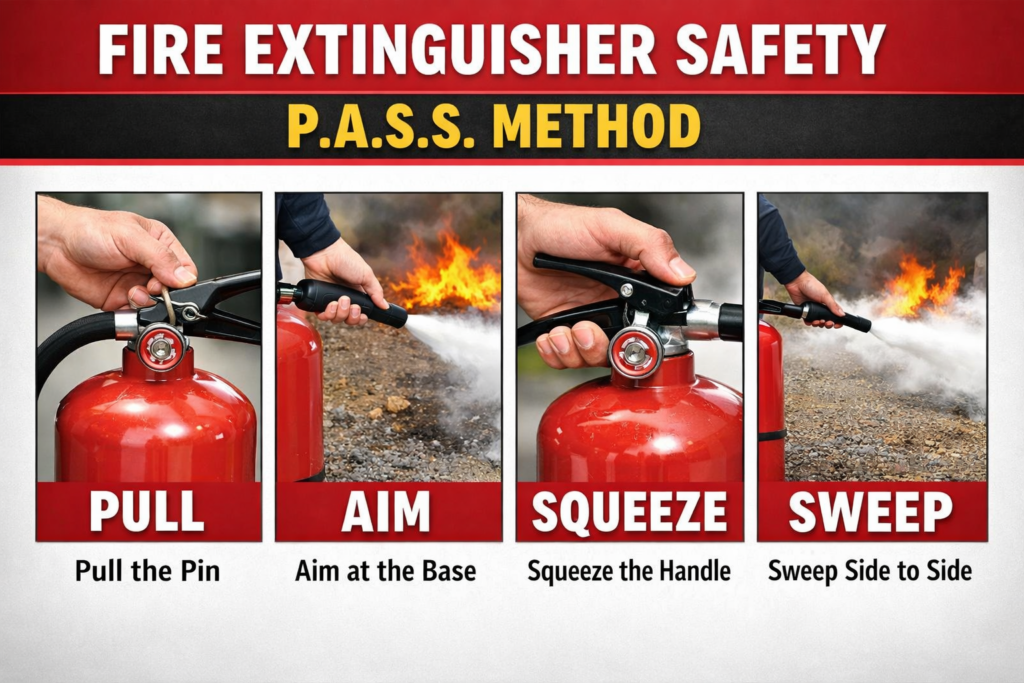
The PASS method is the universally recognised four-step technique for safely and effectively operating a fire extinguisher. PASS is an acronym that stands for Pull, Aim, Squeeze, and Sweep. It applies to all standard portable extinguisher types and is the basis of most workplace fire safety training programmes.
Before attempting to use a fire extinguisher, always ensure three things: the fire alarm has been activated, someone has called the emergency services, and you have identified a clear evacuation route behind you. If any of these conditions are not met, evacuate immediately rather than attempting to fight the fire.
Step 1 — Pull
Pull the safety pin from the extinguisher handle to break the tamper seal. This pin prevents accidental discharge during transport and storage. Without pulling the pin, the extinguisher cannot be activated. Some extinguishers also require breaking a tamper-evident seal as a secondary step.
Step 2 — Aim
Aim the nozzle or hose low, directing it at the base of the fire — not at the flames. This is the most common mistake made by untrained users. The flames are a result of combustion, not the source. Targeting the fuel source at the base is what interrupts the fire triangle. For CO2 extinguishers specifically, do not hold the horn directly, as it becomes dangerously cold during discharge.
Step 3 — Squeeze
Squeeze the handle or lever firmly to release the extinguishing agent. Releasing the handle stops the discharge, so you can control application in short bursts if needed. This is particularly useful with CO2 extinguishers, which have limited discharge duration.
Step 4 — Sweep
Sweep the nozzle or hose from side to side at the base of the fire in a slow, controlled motion, working from the front edge of the fire toward the back. Continue sweeping until the fire appears extinguished. After discharge, watch for reignition, particularly with agents that do not have a long-lasting cooling or smothering effect (such as CO2).
If the fire does not appear to be reducing after 5–10 seconds of correct application, evacuate immediately. Do not persist. Fire extinguishers are designed for small, early-stage fires — not for fires that have already grown beyond initial containment.
Where Should Fire Extinguishers Be Installed in a Building?
Fire extinguishers should be installed at clearly visible, unobstructed locations near potential fire risk areas and at building exits on each floor. UK standard BS 5306-8 specifies that the travel distance from any point in a building to the nearest extinguisher should not exceed 30 metres for lower-risk areas and 10 metres for higher-risk areas — Source: BSI, BS 5306-8, 2012.
Specific placement guidance by extinguisher type includes:
- Water and foam extinguishers should be positioned near exits on floors where Class A or B fire risks have been identified.
- CO2 extinguishers should be positioned near the source of electrical risk — server rooms, switch rooms, office printer areas — and near fire exits.
- Wet chemical extinguishers should be positioned in or immediately adjacent to the kitchen, within reach of the deep fat fryer but not directly above or beside it.
- Dry powder extinguishers should be placed near the specific identified hazard — gas equipment, welding areas, or LPG storage.
All extinguishers should be mounted on a wall bracket or placed on a suitable stand at a height of no more than 1 metre from the floor to the carrying handle, or as specified by the manufacturer — Source: BS 5306-8, 2012. They must be clearly identified with fire safety signage indicating their type and the fire classes for which they are appropriate. For an emergency evacuation plan template that incorporates extinguisher locations, consult your fire risk assessor.
How Often Should Fire Extinguishers Be Inspected and Serviced?
Fire extinguishers should be inspected monthly by a responsible person on the premises and serviced annually by a qualified engineer. This requirement is set out in the UK standard BS 5306-3, and compliance is required as part of the fire risk assessment obligations under the Regulatory Reform (Fire Safety) Order 2005.
The inspection and maintenance schedule works in three tiers:
Monthly visual check (by premises staff):–
- Confirm the extinguisher is in its correct location and unobstructed
- Check that the safety pin and tamper seal are intact
- Verify the pressure gauge reads in the green zone (where applicable)
- Check for visible damage, corrosion, or discharge
- Record the check in the fire safety log
Annual service (by a qualified engineer):–
- Full inspection of the body, hose, nozzle, and operating mechanism
- Weight check to verify the correct agent charge
- Extended discharge test if required
- Replacement of seals and labels as necessary
- Issue of a service label with date and engineer details
Extended service (every 5 years):–
- Hydraulic pressure test of the extinguisher body
- Full recharge or replacement of the extinguishing agent
For a complete fire extinguisher maintenance checklist, maintain records of all monthly checks and annual services as part of your fire safety management documentation. Extinguishers that have been used — even partially — must be recharged or replaced immediately, not left in place and assumed to have sufficient remaining charge.
What Are the Most Common Fire Safety Mistakes During Emergencies?
Common fire safety mistakes during emergencies significantly increase injury risk and allow small fires to escalate into major incidents. Awareness of these mistakes, backed by training, is the most effective way to prevent them.
Mistake 1: Using water on an electrical or oil fire. This is the most dangerous and most common error. Water on a live electrical fire creates an immediate electrocution hazard. Water on burning cooking oil causes a violent steam explosion that spreads burning oil across the kitchen and anyone in it. The correct response to an electrical fire is a CO2 extinguisher; for a cooking oil fire, a wet chemical or water mist.
Mistake 2: Targeting the flames rather than the base. Spraying an extinguisher at the visible flames is instinctive but ineffective. The PASS method specifically requires aiming at the base — the fuel source — to interrupt combustion.
Mistake 3: Standing too close to the fire. Most extinguishers require a minimum safe operating distance. For CO2, the effective and safe range is 1–2.4 metres. Standing closer exposes the user to heat, smoke, and agent risk (particularly frostbite from CO2).
Mistake 4: Neglecting extinguisher maintenance. An extinguisher that has not been inspected or serviced may fail to discharge when needed. Pressure loss, clogged nozzles, and degraded seals are all preventable failures. According to a fire safety audit study, a significant proportion of portable extinguishers on premises fail their first annual inspection due to missed maintenance — Source: Fire Industry Association, 2021.
Mistake 5: Attempting to fight a fire that is already too large. If a fire has spread to more than one item, has reached the ceiling, is producing heavy smoke, or has blocked the exit route, do not attempt to fight it. Evacuate, close doors behind you, and call the emergency services.
For a broader review of common workplace hazards that create fire risk, a formal fire risk assessment is the most effective starting point.
Tools, Examples, and Practical Applications for Fire Safety
A comprehensive fire safety programme requires more than the correct extinguisher — it requires clear signage, documented procedures, trained personnel, and regular practice. The following tools and applications form the practical layer of any fire safety plan.
Fire Safety Signage and Labels
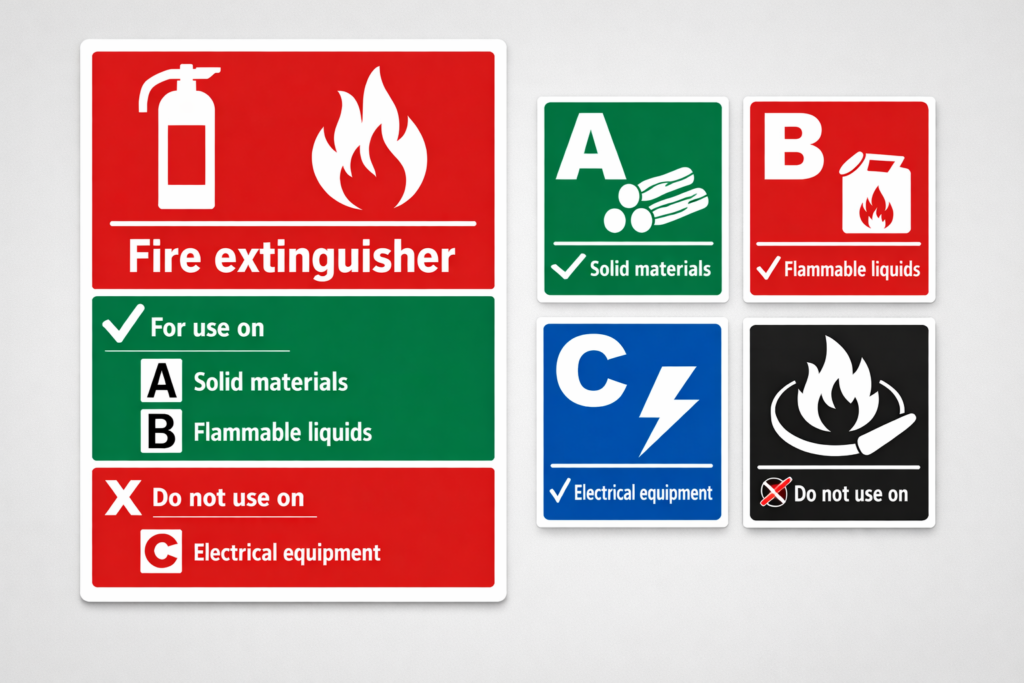
All fire extinguishers must display signage indicating their type, the fire classes for which they are appropriate, and a brief operating instruction. UK fire safety signs must comply with BS ISO 7010, which standardises safety symbols internationally. Signs must be visible from a distance and illuminated or reflective where lighting is poor.
Fire Risk Assessment in Practice
A fire risk assessment identifies the fire hazards present in a premises, the people at risk, and the existing control measures. Under the Regulatory Reform (Fire Safety) Order 2005, all non-domestic premises must have a documented fire risk assessment, reviewed whenever significant changes occur.
For example, a commercial kitchen risk assessment would identify the deep fat fryer as a Class F fire risk and specify that a wet chemical extinguisher of appropriate capacity must be installed within reach. It would also identify the gas supply as a Class C risk and specify that trained staff know how to isolate the supply in an emergency. For guidance on how to conduct a fire risk assessment for your premises, consult a BAFE-accredited fire safety professional.
Workplace Fire Drill Recommendations
A fire drill is the practical test of whether your fire safety plan works in reality. The UK fire safety guidance recommends that workplaces conduct at least one fire drill per year, with larger or higher-risk premises conducting them more frequently — Source: HSE, 2019.
An effective fire drill should test: the speed and completeness of evacuation, the operation of the fire alarm system, the accountability process at the assembly point, and staff familiarity with extinguisher locations and types. For workplace fire safety training resources, fire warden courses and extinguisher training sessions are widely available from accredited fire safety training providers.
Home Fire Safety Checklist
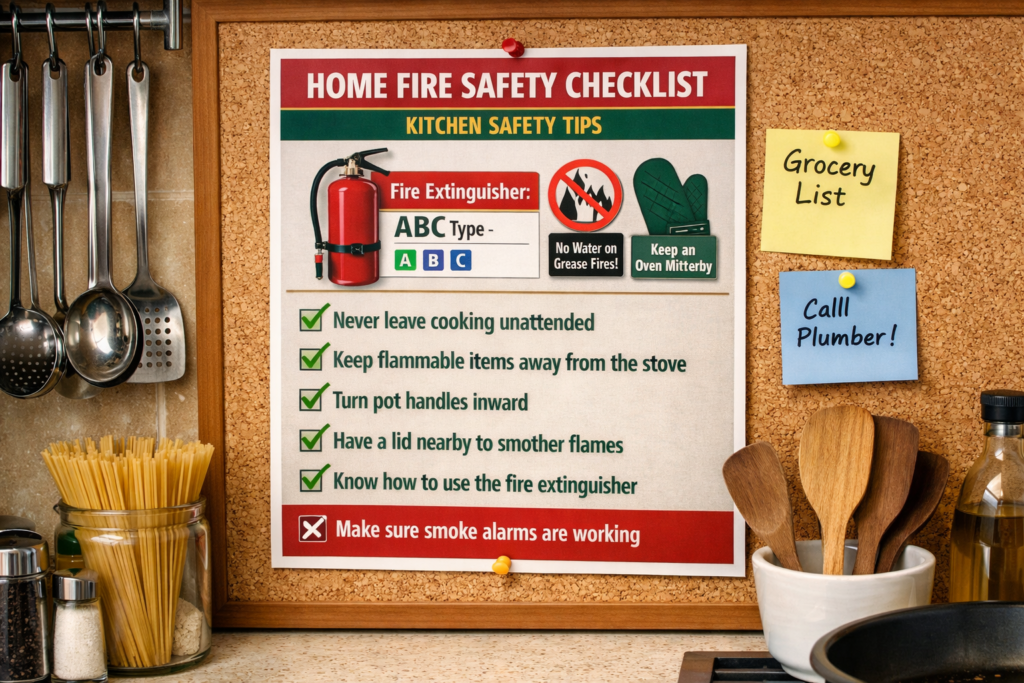
A home fire safety plan should cover:
- Smoke alarms are installed on every floor and tested monthly
- Correct extinguisher in the kitchen (water mist or wet chemical)
- Fire blanket within reach of the cooking area
- Clear evacuation routes identified and practised
- Sleeping arrangements that do not block escape routes
- No charging of lithium-ion devices (phones, e-bikes, e-scooters) overnight or unattended
For a complete fire safety checklist for domestic premises, local fire and rescue services provide free home fire safety visits on request.
What Should You Do Next to Improve Fire Safety?
The most important next step for any premises is to conduct or review a formal fire risk assessment to confirm that the correct extinguisher types, quantities, and placements are in place for the specific risks present in that environment.
Beyond the risk assessment, the following actions build a complete fire safety posture:
Step 1: Audit your current extinguishers. Check the type, size, service date, and location of every extinguisher on your premises against the findings of your fire risk assessment. Replace any extinguisher that is overdue for service, incorrectly positioned, or mismatched to the fire risk.
Step 2: Train every person on the premises. Fire extinguisher training should cover fire class identification, the correct extinguisher type for each risk present on site, and practical PASS method operation. Training should be refreshed at least annually and whenever staff change. For how to prepare for workplace emergencies more broadly, combine extinguisher training with evacuation drills and fire warden certification.
Step 3: Install appropriate extinguishers in every risk zone. This means wet chemical in the kitchen, CO2 near electrical equipment, water or foam in corridors and general areas, and specialist dry powder where flammable metals are present. For types of personal protective equipment worn during fire response in industrial settings, refer to your site-specific EHS guidance.
Step 4: Schedule annual servicing. Book your annual extinguisher service with a BAFE-accredited provider and maintain a written record of all service visits. Set a calendar reminder for monthly visual checks.
Step 5: Review and update regularly. Any change to the building layout, occupancy type, process, or materials present should trigger a review of the fire risk assessment and extinguisher provision. Fire safety is not a one-time installation; it is an ongoing management commitment.
Conclusion
Understanding the types of fire and fire extinguishers is not just a technical detail — it is a fundamental safety skill that directly determines what happens in the first moments of a fire emergency. Choosing the correct extinguisher can contain a small fire before it becomes a major incident. Choosing the wrong one can transform a manageable situation into a life-threatening one.
The core principle is simple: match the extinguisher to the fire class. Class A fires need water, foam, or water mist. Class B fires need foam, CO2, or dry powder. Electrical fires need CO2. Class F cooking fires need wet chemical. And Class D metal fires need specialist dry powder.
Beyond selection, regular inspection and maintenance ensure the extinguisher will work when needed. Training ensures the person holding it will know what to do. And a documented fire safety plan ensures that the building, its occupants, and its contents are protected as a coherent system — not by individual equipment in isolation.
The best time to review your fire safety provision is today, before an emergency makes the decision for you. Take a walk through your premises. Locate every extinguisher. Check its service label. Confirm it is the right type for the fire risks around it. That one action, repeated regularly, is what fire preparedness looks like in practice.
Written by: SHANKAR PAREKAR, Fire Safety Specialist — Brief expertise of 27 years of experience in commercial fire risk assessment and fire safety compliance across industrial and commercial sectors.
Reviewed by: SHIV DASS, BAFE-registered fire safety engineer and certified fire risk assessor with expertise in BS 5306 compliance and industrial fire suppression systems.
Disclaimer: This article was initially drafted using AI assistance. However, the content has undergone thorough revisions, editing, and fact-checking by human editors and subject matter experts to ensure accuracy. All fire safety decisions for your specific premises should be based on a formal fire risk assessment conducted by a qualified professional.
Sources Referenced
Fire Industry Association. Annual Extinguisher Inspection Audit Data. FIA, 2021.
National Fire Protection Association (NFPA). NFPA 10: Standard for Portable Fire Extinguishers. 2022 Edition.
UK Government. Regulatory Reform (Fire Safety) Order 2005. HM Government, 2005.
British Standards Institution. BS 5306-3: Commissioning and maintenance of portable fire extinguishers. BSI, 2017.
British Standards Institution. BS 5306-8: Selection and positioning of portable fire extinguishers. BSI, 2012.
British Standards Institution. BS EN 3: Portable fire extinguishers. BSI, Current edition.
UK Home Office. Fire Statistics Great Britain. Home Office, 2023.
Fire Industry Association. UK Fire Extinguisher Use Survey. FIA, 2022.
Health and Safety Executive (HSE). Fire safety in the workplace. HSE, 2019.
Pingback: What is a Class A Fire? Causes & Safety Guide